
Best Salmon Fishing Rods and Reels: 5 Picks and Setup Guide
By Jake Harlow · Updated September 2026 · As an Amazon Associate, Tetra Hook earns from qualifying purchases. Disclosure.
Short answer: for most salmon fishing from a river bank or a drift boat, choose an 8’6″ to 9’6″ medium or medium-heavy rod with a moderate-fast action. The Okuma Celilo is the Pacific Northwest’s go-to value salmon and steelhead rod, and pairs well with a sealed, metal-bodied spinning reel like the PENN Battle IV DX 4000. If you troll from a boat, add a line-counter reel such as the Daiwa Accudepth. On a budget, the Ugly Stik Bigwater combo is a tough, ready-to-fish setup.
Our picks at a glance
| Rod or reel | Why | Type | Price |
|---|---|---|---|
| Okuma Celilo 8’6″ Medium Spinning Rod | Best salmon rod overall | Rod | $$ |
| Okuma Celilo 9’6″ Medium Casting Rod | Best casting rod for drifting and plunking | Rod | $$ |
| PENN Battle IV DX 4000 | Best spinning reel | Reel | $$$ |
| Daiwa Accudepth Plus Line Counter | Best trolling reel | Reel | $$ |
| Ugly Stik Bigwater Spinning Combo | Best budget rod and reel combo | Combo | $$ |
Prices change often; $$ is $75–$150 and $$$ is over $150 at the time of writing. Rods come in several lengths and powers: the links open the version we recommend, and you can switch on the Amazon page.
How we picked
This is a researched guide. Salmon are big, strong fish that are often hooked in current, so we looked for rods long enough to control line and steer fish, with enough backbone for chinook but a tip soft enough to fish drift rigs, floats and spinners; and for reels with smooth, strong drags, enough line capacity and good sealing against water and grit. Specifications come from the manufacturers; performance notes come from experienced salmon anglers’ published advice and verified buyer reviews. We checked every rod and reel on Amazon in September 2026. Many salmon rods, including several Okuma, Ugly Stik and Shimano models, were unavailable at the time, so the list is short on purpose: every item on it can be ordered.
The best salmon rods
1. Best salmon rod overall: Okuma Celilo 8’6″ Medium Spinning
Okuma’s Celilo series is named after Celilo Falls on the Columbia River and is one of the most popular value salmon and steelhead rods in the Pacific Northwest. The updated “b” models use a graphite composite blank with Okuma’s UFR-II reinforced tip for durability, titanium-oxide guide inserts, stainless steel reel seat hoods and tapered cork grips. The 8’6″ medium spinning model is a versatile length for casting spinners and spoons, fishing jigs under a float, and fighting coho, pinks and smaller chinook from the bank.
- Good: proven salmon/steelhead design, light and sensitive, very good value.
- Watch out: for big kings in heavy current, step up to a medium-heavy model.
2. Best casting rod for drifting and plunking: Okuma Celilo 9’6″ Medium Casting
Many river salmon anglers prefer a long casting rod with a levelwind reel for drift fishing, bottom bouncing, back-bouncing and plunking with bait. The 9’6″ medium casting Celilo gives you the length to keep line off the water and lift fish away from rocks, with the same blank and components as the spinning model.
- Good: long reach for drift and plunk rigs, pairs with levelwind or line-counter reels.
- Watch out: a 9’6″ rod needs room in the vehicle; stock on Amazon was low when we checked.
The best salmon reels
3. Best spinning reel: PENN Battle IV DX 4000
A salmon reel needs a strong, smooth drag and a body that stays aligned under load. The Battle IV DX has a full metal body, sideplate and rotor, stainless steel main and pinion gears, and PENN’s HT-100 carbon fiber drag. The 4000 size holds plenty of 12–15 lb mono or 30 lb braid for river salmon and balances an 8’6″ to 9′ rod; go to the 6000 for big chinook or saltwater mooching and casting.
- Good: tough, smooth drag, works in fresh and salt water, very well reviewed.
- Watch out: heavier than graphite-bodied reels; costs more than budget spinning reels.
4. Best trolling reel: Daiwa Accudepth Plus Line Counter
When you troll for salmon from a boat, you need to put your lure at the same depth every time. A line counter shows exactly how much line is out, so when a rod gets bit you can repeat that depth on every rod. Daiwa’s Accudepth Plus is a levelwind trolling reel with a line counter that reads in feet. The size 15 model we link is the compact one, suited to kokanee, coho and lighter trolling; for chinook with divers, weights or downriggers, choose the larger 27 or 47 size if it is in stock.
- Good: accurate depth control, levelwind, pairs with a trolling or long casting rod.
- Watch out: the size 15 is small for big kings; this listing has few reviews so far.
5. Best budget combo: Ugly Stik Bigwater Spinning Combo
If you want one rod and reel to try salmon fishing from piers, jetties, boats and big rivers, the Ugly Stik Bigwater combo is a tough, inexpensive start. The glass-and-graphite rod is very hard to break and the matched spinning reel has corrosion-resistant components for saltwater use.
- Good: very durable, ready to fish, handles salt and fresh water.
- Watch out: heavier and less sensitive than a dedicated salmon rod; choose a length of 8′ or more.
How to choose a salmon rod and reel
| Technique | Rod length | Power | Reel | Main line |
|---|---|---|---|---|
| Casting spinners and spoons | 8’–9′ | Medium | 3000–4000 spinning | 10–15 lb mono or 20–30 lb braid |
| Float fishing | 9’6″–10’6″ | Medium to medium-light | Spinning or baitcasting | 10–15 lb mono or 20–30 lb braid |
| Drift fishing and plunking | 8’6″–10’6″ | Medium to medium-heavy | Levelwind baitcasting | 15–25 lb mono or 30–50 lb braid |
| Trolling from a boat | 8’6″–10’6″ | Medium-heavy | Line-counter levelwind | 20–30 lb mono or 40–65 lb braid |
| Pier, jetty and surf | 9’–11′ | Medium-heavy to heavy | 5000–6000 spinning | 20–30 lb braid with a mono leader |
- Length: longer rods control line in current, cast further and keep fish away from rocks; shorter rods are easier in a boat.
- Power: medium for coho, pinks, sockeye and steelhead; medium-heavy for chinook (king) salmon.
- Action: a moderate-fast action absorbs head shakes and jumps without tearing hooks free.
- Line capacity: a big king can run 100 yards; see how many yards of line for salmon fishing.
- Spinning or casting: spinning is easier for casting light lures and floats; levelwind casting reels are better for drift fishing, plunking and trolling.
Salmon fishing techniques
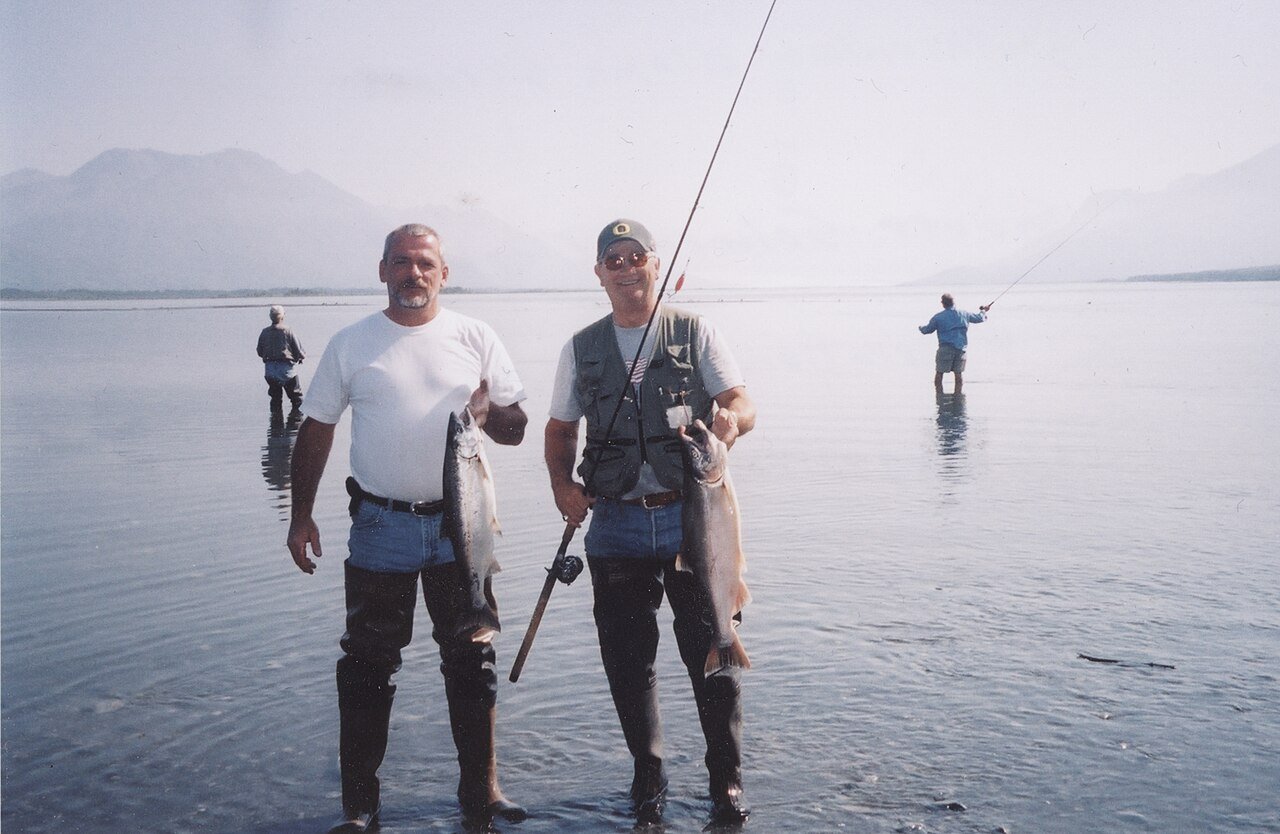
The right rod depends on how you fish. Our technique guides explain each method in detail:
- Spin fishing for salmon with spinners and spoons
- Float fishing for salmon
- Jigging for salmon in rivers
- How to rig skein for bait fishing
- The best salmon lures for river fishing
Frequently asked questions
What is the best rod for salmon fishing?
For most river and bank fishing, an 8’6″–9’6″ medium or medium-heavy rod such as the Okuma Celilo. Use a longer rod for float fishing and a medium-heavy trolling rod in a boat.
What size reel for salmon?
A 3000–4000 spinning reel for coho, pinks and steelhead; a 4000–6000 spinning reel or a mid-size levelwind for chinook. Trolling anglers use line-counter reels.
Can I use a steelhead rod for salmon?
Yes for coho, pinks and sockeye; most rods are sold as salmon/steelhead rods. For big chinook, choose medium-heavy power.
What pound line for salmon?
10–15 lb for coho and pinks, 15–25 lb mono or 30–50 lb braid for chinook, usually with a fluorocarbon leader. Check local rules, as some rivers restrict braid or hooks.
Spinning or baitcasting for salmon?
Spinning is easier for casting lures and floats. Baitcasting and levelwind reels give more control for drift fishing, plunking and trolling.